How to differentiate between using blogs and note? Tips for running a two-platform business where creative work circulates.
Pochi
Reading in the sun and reading in the rain.

I've tried countless notebooks, but I just can't stick with it. Before I know it, the number of blank pages just keeps increasing.
A small feeling of guilt, like "I couldn't write again...", piled up, and before I knew it, even opening my notebook became a burden.
But as I continued to analyze myself, the reason finally became clear.
The reason it didn't last wasn't a personality issue,It was simply that the way it was used didn't suit my personality.That's how it was.
From that point on, my approach to taking notes changed dramatically.
Now, I've finally settled on a way of using it that feels right deep down, something I can stick with.
For instructions on how to use the notebook in the past, please click here.
 [September 2026] A new way of using a notebook that suits me as an INTP
First, here is a list of the notebooks I used previously.
・Midori's "MD Notebook A5 Dot Grid"
Used as a daily diary. A casual, free-spirited writing style.
・Midori's "MD Notebook A5 Grid"
Reading journal. A record of the books I've read.
・Midori's "MD Notebook A5 Thick Paper Plain"。
Watercolor illustration notebook.
・KOKUYO's "Surveyor's Notebook"
A task management and journal designed to be used up in one month.
A neatly organized notebook setup, categorized by purpose—a so-called "ideal notebook configuration."
But as I continued, a small feeling of unease began to build up deep inside me.
Every time a page remains blank, I think, "I couldn't write anything again..."Guilt。
I bought a new notebook and excitedly opened the first page, but the fact that it didn't resonate with me at all only intensified my guilt.
And the moment I realized it, what hit me was..."I can't stick with things." That is,despairThat's it.
I've always felt something was off.
But I didn't know how to improve it.
"I have a feeling this isn't the right way to use it," I thought, but I still couldn't find the "correct way," and the number of blank pages just kept increasing.
Those accumulated experiences had become a major obstacle for me.
As I continued my self-analysis (using methods like fortune-telling, MBTI, and palmistry), the analysis results from the AI resonated deeply with me.
The reason I couldn't keep up with keeping a diary wasn't laziness, but rather my inherent nature.
A diary is an act of repeating the "same format," "same time," and "same actions."
But the brain of an INTP is This type of person is motivated by "change," "novelty," and "a switch that sparks their interest."
Writing the same thing every day = the brain doesn't get stimulated → you get bored quickly → you can't keep it up.
This is entirely "by design."
Diaries are often about "what you did today," but INTPs “Meaningless records”I really hate that.
When you feel this way, your brain decides that "there's no point in doing it."
INTP "Organizing thoughts," "Discovering ideas," "Analyzing emotions"Meaningful sentences like this can be continued, but mere records cannot.
While keeping a diary is based on the premise of "writing every day," INTPsA type of person whose mood swings directly affect their level of activity.。
This is not laziness, Your brain is simply choosing "what needs to be done now."
Therefore, the rule of "writing every day" simply doesn't suit me.
A diary is about "what happened today," but for INTPs...Abstract concepts, awareness, emotionsI'm better at adapting to change.
I can keep up with this kind of "abstract diary," but I'm not good at the "What did I do today" format.
Diaries are cumulative (you build them up day by day), but INTPs are discovery-based (they write everything down all at once when they notice something).
that's whyI'm better suited to writing deeply whenever I have a moment to spare, rather than writing a little bit every day.
In other words,INTPs are not "people who can't keep a diary," but rather "people who are not suited to the diary format."
If you want to continue, here's how to improve compatibility:
INTP is not a "diary" “Thought Log” This one is overwhelmingly more common.
No matter which AI I asked, the answer was similar.
Considering my own past experiences with keeping a diary, it's become clear that keeping a diary is completely unsuitable for my personality.
the current,Traveler's NotebookとSurvey field notebookとMD NotebookThis is the structure we're continuing with.
When my father's friend went to London, England, he brought back a Harry Potter Traveler's Notebook as a souvenir.
Both the front and back are simple, creating a calm atmosphere with a touch of playfulness in the design.
It comes with both dot grid and blank refills, and I currently use the two notebooks for different purposes.
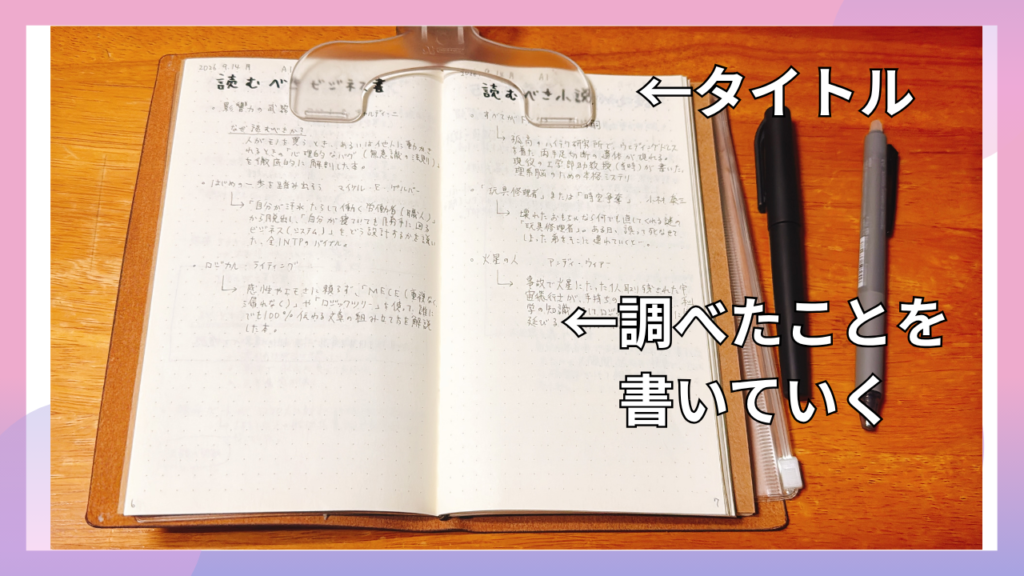
Because INTPs have a strong intellectual curiosity, they are more likely to stick with "writing in depth when something sparks their interest" rather than "writing every day."
This notebook summarizes what I've learned from YouTube and other sources.
It's a simple format: just write the title with a thick pen and then list the points you think are important below it.
By writing the date and source of information in small letters above the title, you can quickly see "when and where the knowledge was obtained" when you look back at it later.
I also include a table of contents to make it easier to search later.
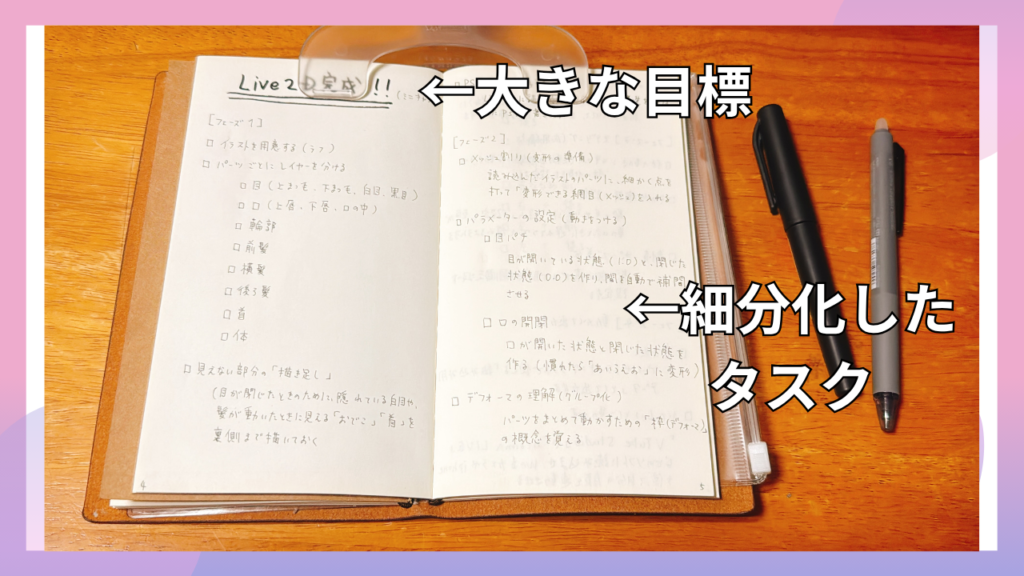
I use the other blank refill as a notepad for breaking down tasks.
INTPs seem to have a characteristic of treating things that aren't in front of them as non-existent, so they often quickly forget tasks that aren't within their field of vision.
I honestly wish I had known about this property sooner.
Therefore, I use this notebook to break down "tasks that can be done in a day" that I would normally write on sticky notes to put on the wall.
Currently, I've only written down the Live2D goals, but in the future, I plan to break them down further in consultation with the AI as new goals emerge.
I used to follow a rule of "using up one notebook per month" when writing in my field notebook, but I just couldn't keep it up.
My writing volume and mood fluctuate, so I think the format of filling up a page every day just didn't suit me.
Right now, I'm using this notebook. “A notebook for recording only completed tasks.” I'm using it as such.
The content you write is very simple; just leave a single line with the date and what you accomplished, such as "2026.9.20 Illustration rough draft completed."
What we are careful about here is,Don't write every day。
I try to write it once all my tasks are finished.
Normally, I write tasks on sticky notes and only note the date I completed them.
When collecting sticky notes, writing the date on them into the field notebook gives a sense of progress and leads to a feeling of accomplishment.
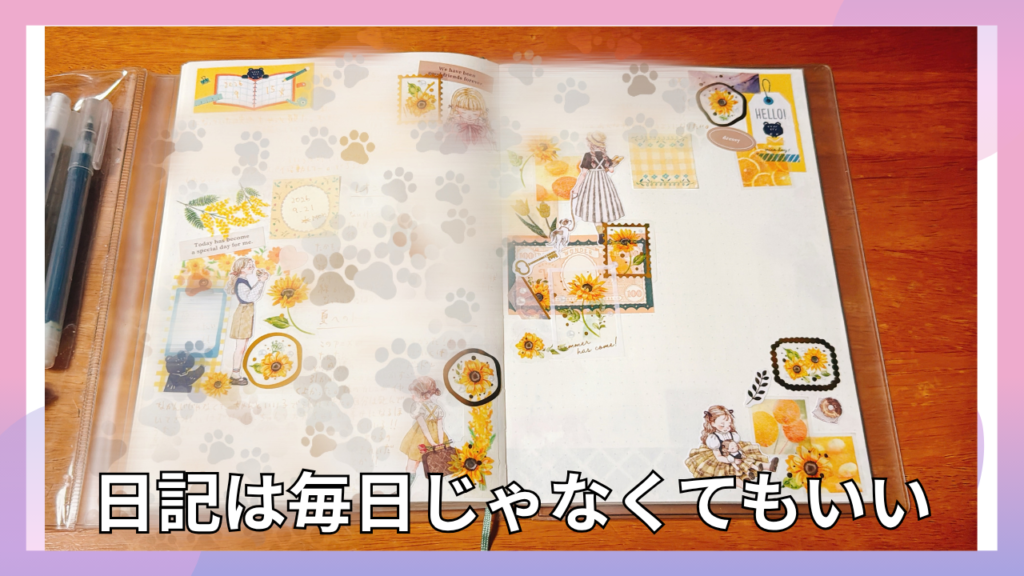
I continue to use my MD notebook as my daily journal, just as before.
However, this does not assume that you will write every day.
This is a notebook I only open when I want to regulate my emotional state, such as when I feel restless, when I have lingering doubts, or conversely, when I'm feeling exhilarated.
On days when I don't feel like writing, I don't write at all, but on days when I do feel like writing, I can write long pieces.
By simply accepting those fluctuations, we've been able to continue without any burden.
I often lightly decorate the pages with stickers, making it a notebook that visually lifts my spirits.
It's a simple process: when you're done with one, just buy another MD notebook.
I used to use it as a reading journal, but I couldn't keep it up, so now I've consolidated it into a daily diary.
I could never stick to managing my schedule with a physical planner, so now I use the calendar function on my smartphone.
Setting up notifications has significantly reduced the instances where I used to forget something I'd written in my planner.
I'm not good at sticking to schedules, and I find that managing tasks visually with sticky notes works better for me than dividing them into time slots.
Therefore, I don't put small tasks in my smartphone calendar; I only register work appointments.
By only including the necessary information, the burden of checking the calendar is reduced, making it easy to continue using it without difficulty.

I've been diagnosed as an INTP three times now, and the result has been the same all three times.
Based on that characteristic, I consulted with AI to re-evaluate what kind of note-taking method would suit me best, and that's how I arrived at this current structure.
Once you understand your own personality and how you use notebooks and planners, a comfortable and natural approach will naturally emerge.
The reasons why you couldn't continue shouldn't be used to blame yourself, but rather as clues to find a method that suits you better.
If there are others who are struggling with similar issues, I think it would be a good opportunity to try some self-analysis.
If you found this article helpful and would like to support it,
Receiving encouragement from OFUSE is very motivating.
Your support will be instrumental in creating illustrations and updating my blog.
Thank you very much for reading to the end.
Thanks to everyone who always reads my work, I can continue to create.
I look forward to your continued support.